A report conducted by Nielson Company in 2016 found that adult Americans spend nearly 11 hours a day looking at a screen–and that was before the pandemic. It’s safe to say we are liekly slaves to the screen and tech zombies to the tenth degree. But screens are always a valuable part of our lives, according to The Independent. As they bring out, screens have “become a crucial lifeline, not least in helping people to be socially connected even whilst physically disconnected”.
Even still, 11 hours a day is a long time. After all, if you were going to expose one of your five senses to a potentially dangerous substance, would you take precautions? Fire and rescue workers wear gloves, carpenters wear knee pads and factory workers wear hearing protection. What about your eyes?

And just as screens are a part of our lives, so is the blue light they emit.
But, what is blue light? Is it dangerous? And what should be considered when purchasing blue light eyeglasses?
What is Blue Light?
Light travels in waves and is made of electromagnetic particles. You may recognize these as the order and colors of the rainbow. When combined, they produce white light or polychromatic light which the sun produces. Individually, they vary in wavelength and energy. This energy is measured in nanometers, or a billionth of a meter. Visible light ranges from 750 nm (red) and decreases as you move through the light spectrum, violet being 380 nm.

You may think high wavelengths mean more energy, but the opposite is true. The lower the wavelength means higher energy. Just think of blue light as a small but lightning fast car such as a Porsche Spyder. It may be small, but it is mighty.

This powerful light is everywhere. Before the invention of laptops, computers, TVs, cell phones, gaming systems, and fluorescent lights, our sun was the only source of blue light. But in our modern age, blue light is as much a part of our lives as washing machines and coffee makers. Digital devices emit blue light 430-500 nm.
Not all blue light is bad. Research has found that blue light exposure in the morning leads to quicker reaction times, and stronger memory performance. It is said to promote a healthy circadian rhythm by elevating alertness, balancing sleep and wake patterns, and heighten your mood. However, it can have a dark side.
According to a study done in 2020 by Harvard, blue light was identified as a cause of sleeplessness. How does it do this?
A Background Check on Blue Light
Humans have a biological clock set at 24 hours. We naturally awaken when exposed to the sun. When we are in contact with the earth’s natural light, it suppresses the release of melatonin and cortisol which manage sleep cycles. As the sun sets and the light fades, these hormones increase and tell our brain it’s time for bed.
Our eyes are one of the most complex organs in our body. As day fades into dusk, our eyes are able to seamlessly adjust for low light through a series of electrical signals. Fred Rieke put it best when he said, “Even the most sophisticated digital camera today cannot cope with the range of inputs your visual system can handle.” But for all astounding feats the eye can make, it is not good at filtering out blue light.
Even the most sophisticated digital cameras today cannot cope with the range of inputs your visual system can handle.
Fred Rieke
Before the age of artificial illumination, humans used lamps made from pottery, torches, and by the 19th century wax candles. These forms of light have little effect on our circadian system as they are low intensity, or have less powerful wavelengths.
In 1882 when the lightbulb was invented, most Americans powered their homes with gas lighting and candles for another fifty years. Enter the psychedelic 1960’s, when love was free and the demand for high intensity lighting grew leaps and bounds. However, not everyone was feeling the luminary love.
After the launch of light-emitting diodes (LED), scrutiny and skepticism followed. By the 1970’s research was conducted to settle the debate and answer whether or not blue light was dangerous. In these studies, test subjects were asked to stare into a blue LED light and in some cases, minor inflammation of the retina was detected.
What about sleep? Brigham’s Division of Sleep and Circadian Disorders found that the “body’s natural circadian rhythms were interrupted by the short-wavelength enriched light, otherwise known as blue light, from these electronic devices,” said Anne-Marie Chang, PhD.
Protection From Blue Light
Now that we know blue light can cause inflammation to the retina and disrupt sleep cycles, how do we protect our eyes? If you’re going to spend a day at the beach you’d be wise to use sunscreen. No, we don’t recommend slathering your kid’s sunscreen into your eyes next time you check Instagram. Ouch. So how can you protect your eyes?

For some time, it was thought we could control blue light from our screens simply by activating Night Mode. But according to research done in 2018, there was no significant benefit in simply changing the screen’s color or reducing the brightness, blue light is still emitted.
Here are a few tips:
- Rest your eyes by taking breaks every hour. Follow the 20-20-20 rule. Every 20 minutes look at something 20 feet away for 20 seconds. Break reminder apps such EyeCare 20 20 20 can help you from getting sucked into the screen too long. Available on Android or iOS.
- Sleep in a dark room and avoid using a lamp or nightlight.
- Avoid looking at a bright screen several hours before going to sleep.
- Use blue light filtering glasses.
Mediocre Copies
There are many blue light glasses on the market today, and with that many more misconceptions. They can vary greatly in price from $17 up to several hundred. But, like many knock-off items, you get what you pay for.
So, how do you avoid buying mediocre blue light eyeglasses?

As we already discussed, blue light ranges between 450-500 nanometers while violet falls between 380-450. But only some of that light is dangerous. Wavelengths at 440-500 nm disrupted sleep cycles by suppressing melatonin production. Digital devices emit blue light at a high peak of 455 nm. So the ideal blue light eyeglasses should cover as high a percentage as possible from 455 nm of blue light.
Many glasses on the market offer blue light coatings, which is a layer that rests on the outside of the lens. They are appealing to many because they are generally clear or have a blue/violet reflection on the lens.
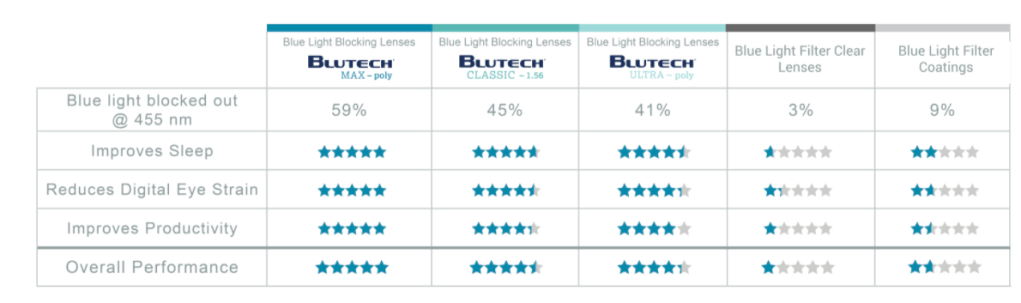
Unfortunately, these blue light coatings only filter out some 3%-9% of dangerous blue light at 455 nm. Would you feel comfortable using other safety gear such as seat belt, oven mitts, or a hard hat if it was only 3%-9% effective?
If you come across blue light eyeglasses that claim to filter high energy light at 455 nm you’ll need to ask, what percentage of 455 nm is being protected?
The Gold Standard: BluTech
BluTech is one of the only true blue light-filtering lenses on the market today. It stands apart from the other impersonators by blocking out an impressive 41%-59% of blue light at 455 nm. Note its overall performance in comparison to other filters and coatings available. Find genuine blue light protection near you by searching for “Where To Buy” on BluTech’s website.
In Summary
The bottom line is not all blue light filtering glasses are equal. There are a lot of counterfeits out there. Which is important to know, because screens and exposure to blue light will continue to be a part our lives. So do your research to know with 100% certainty that you are buying the best protection available.
 The In-sight-ful Optician